What Type of Art Did John James Audubon Have
| John James Audubon FRS | |
|---|---|
 Portrait of Audubon by John Syme, 1826 | |
| Built-in | Jean-Jacques Rabin (1785-04-26)April 26, 1785 Les Cayes, Saint-Domingue (later Haiti) |
| Died | January 27, 1851(1851-01-27) (aged 65) New York City, New York, U.S. |
| Citizenship | France and U.s.a. |
| Occupation | self-trained artist, Naturalist, ornithologist |
| Spouse(south) | Lucy Bakewell (m. 1808) |
| Signature | |
 | |
John James Audubon (born Jean Rabin; April 26, 1785 – Jan 27, 1851) was an American cocky-trained artist, naturalist, and ornithologist. His combined interests in art and ornithology turned into a programme to brand a consummate pictorial record of all the bird species of Northward America.[1] He was notable for his extensive studies documenting all types of American birds and for his detailed illustrations, which depicted the birds in their natural habitats. His major work, a colour-plate volume titled The Birds of America (1827–1839), is considered ane of the finest ornithological works e'er completed. Audubon is also known for identifying 25 new species. He is the eponym of the National Audubon Society, and his name adorns a large number of towns, neighborhoods, and streets in every office of the United States.[2] Dozens of scientific names offset published past Audubon are currently in use past the scientific customs.[3]
Among recent reappraisal of figures involved with slavery, the Audubon Naturalist Society appear in October 2021 that they intended to alter the name, citing Audubon'south ownership of slaves, opposition to the abolitionism of slavery, and support for the supposed inferiority of black and indigenous people.[4]
Early on life [edit]
Audubon was born in Les Cayes in the French colony of Saint-Domingue (now Haiti)[five] on his father's sugarcane plantation. He was the son of Lieutenant Jean Audubon, a French naval officeholder (and privateer) from the south of Brittany,[half-dozen] and his mistress, Jeanne Rabine,[7] a 27-yr-old chambermaid from Les Touches, Brittany (now in the modern region Pays de la Loire).[6] [eight] They named him Jean Rabin.[eight] Another 1887 biographer has stated that his mother was a lady from a Louisiana plantation.[nine] His mother died when he was a few months old, every bit she had suffered from tropical disease since arriving on the isle. His father already had an unknown number of mixed-race children (amongst them a daughter named Marie-Madeleine),[10] some by his mixed-race housekeeper, Catherine "Sanitte" Bouffard[10] (described as a quadroon, meaning she was 3-quarters European in ancestry).[11] Post-obit Jeanne Rabin's death, Audubon renewed his human relationship with Sanitte Bouffard and had a daughter past her, named Muguet. Bouffard also took care of the infant boy Jean.[12]
The senior Audubon had commanded ships. During the American Revolution, he had been imprisoned by Great britain. After his release, he helped the American crusade.[13] He had long worked to salve money and secure his family'due south time to come with real manor. Due to slave unrest in the Caribbean, in 1789 he sold role of his plantation in Saint-Domingue and purchased a 284-acre farm called Manufacturing plant Grove, 20 miles from Philadelphia, to diversify his investments. Increasing tension in Saint-Domingue between the colonists and the African slaves, who greatly outnumbered them, convinced the senior Jean Audubon to return to France, where he became a member of the Republican Guard. In 1788 he arranged for Jean and in 1791 for Muget to exist transported to France.[fourteen] [15] [16]
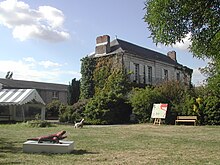
La Gerbetière, mansion owned by Audubon's father in Couëron, where immature Audubon was raised
The children were raised in Couëron, near Nantes, France, by Audubon and his French wife, Anne Moynet Audubon, whom he had married years before his time in Saint-Domingue. In 1794 they formally adopted both the children to regularize their legal condition in France.[15] They renamed the boy Jean-Jacques Fougère Audubon and the girl Rose.[17]
From his earliest days, Audubon had an analogousness for birds. "I felt an intimacy with them...bordering on frenzy [that] must accompany my steps through life."[18] His father encouraged his interest in nature:
He would betoken out the elegant movement of the birds, and the beauty and softness of their plumage. He called my attention to their show of pleasure or sense of danger, their perfect forms and splendid attire. He would speak of their departure and render with the seasons.[19]
In France during the cluttered years of the French Revolution and its aftermath, the younger Audubon grew upwards to exist a handsome and gregarious man. He played flute and violin, and learned to ride, fence, and trip the light fantastic.[20] A great walker, he loved roaming in the forest, frequently returning with natural curiosities, including birds' eggs and nests, of which he fabricated crude drawings.[21] His begetter planned to make a seaman of his son. At twelve, Audubon went to armed services school and became a cabin boy. He quickly found out that he was susceptible to seasickness and not fond of mathematics or navigation. After declining the officer's qualification test, Audubon ended his incipient naval career. He was cheerfully back on solid ground and exploring the fields again, focusing on birds.[22]
Immigration to the United States [edit]

In 1803, his father obtained a false passport and then that Jean-Jacques could become to the Usa to avert conscription in the Napoleonic Wars. 18-twelvemonth-old Jean-Jacques boarded ship, changing his proper name to the anglicized grade John James Audubon.[23] Jean Audubon and Claude Rozier arranged a business organization partnership for their sons John James Audubon and [Jean Ferdinand Rozier] to pursue pb mining in Pennsylvania. The Audubon-Rozier partnership was based on Claude Rozier's buying half of Jean Audubon's share of a plantation in Republic of haiti, and lending coin to the partnership every bit secured past half interest in pb mining at Audubon's property of Mill Grove.[24] [25]
Audubon caught yellow fever upon arrival in New York City. The transport's captain placed him in a boarding house run past Quaker women. They nursed Audubon to recovery and taught him English, including the Quaker course of using "thee" and "thou", otherwise then primitive. He traveled with the family's Quaker lawyer to the Audubon family subcontract Mill Grove.[26] The 284-acre (115 ha) homestead is located on the Perkiomen Creek a few miles from Valley Forge.
Audubon lived with the tenants in the 2-story stone firm, in an area that he considered a paradise. "Hunting, fishing, drawing, and music occupied my every moment; cares I knew not, and cared naught virtually them."[20] Studying his surroundings, Audubon speedily learned the ornithologist'south rule, which he wrote down as, "The nature of the place—whether high or low, moist or dry out, whether sloping north or south, or bearing tall copse or low shrubs—generally gives hint as to its inhabitants."[27]
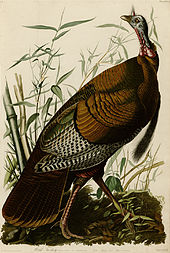
Plate one of The Birds of America by Audubon depicting a wild turkey
His father hoped that the lead mines on the property could exist commercially developed, equally lead was an essential component of bullets. This could provide his son with a profitable occupation.[28] At Mill Grove, Audubon met the owner of the nearby Fatland Ford estate, William Bakewell, and his daughter Lucy Bakewell.
Audubon set about to written report American birds, adamant to illustrate his findings in a more than realistic manner than well-nigh artists did then.[29] He began drawing and painting birds, and recording their behavior. After an adventitious autumn into a creek, Audubon contracted a astringent fever. He was nursed and recovered at Fatland Ford, with Lucy at his side.
Risking conscription in France, Audubon returned in 1805 to run into his father and ask permission to ally. He also needed to discuss family business plans. While at that place, he met the naturalist and dr. Charles-Marie D'Orbigny, who improved Audubon's taxidermy skills and taught him scientific methods of research.[30] Although his return send was overtaken by an English language privateer, Audubon and his hidden gilded coins survived the encounter.[31]
Audubon resumed his bird studies and created his ain nature museum, peradventure inspired by the great museum of natural history created past Charles Willson Peale in Philadelphia. Peale'due south bird exhibits were considered scientifically advanced. Audubon'due south room was brimming with birds' eggs, stuffed raccoons and opossums, fish, snakes, and other creatures. He had become expert at specimen preparation and taxidermy.
Deeming the mining venture too risky, with his father'southward approval Audubon sold function of the Factory Grove farm, including the house and mine, but retaining some land for investment.[32]
Banding experiment with Eastern Phoebes [edit]
In volume ii of Ornithological Biography (1834), Audubon told a story from his childhood, xxx years subsequently the events reportedly took place, that has since garnered him the label of "first bird bander in America".[33] The story has since been exposed as likely counterfeit.[34] In the spring of 1804, according to the story, Audubon discovered a nest of the "Pewee Flycatcher", at present known as Eastern Phoebe (Sayornis phoebe), in a small grotto on the property of Manufacturing plant Grove. To determine whether the other phoebes on the belongings were "descended from the same stock", Audubon (1834:126) said that he tied silverish threads to the legs of five nestlings:
I took the whole family unit out, and blew off the exuviae of the feathers from the nest. I attached lite threads to their legs: these they invariably removed, either with their bills, or with the assistance of their parents. I renewed them, notwithstanding, until I plant the little fellows habituated to them; and at last, when they were about to exit the nest, I fixed a light argent thread to the leg of each, loose enough not to hurt the office, just so fastened that no exertions of theirs could remove it.[35]
He too said that he had "ample proof afterwards that the brood of young Pewees, raised in the cave, returned the following spring, and established themselves farther up on the creek, and amongst the outhouses in the neighbourhood … having defenseless several of these birds on the nest, [he] had the pleasure of finding that two of them had the lilliputian ring on the leg", just multiple contained primary sources (including original, dated drawings of European species[36]) demonstrate that Audubon was in France during the spring of 1805, non in Pennsylvania as he later claimed.[34] Furthermore, Audubon's merits to have re-sighted two out of 5 of the banded phoebes as adults (i.e., a 40% charge per unit of natal philopatry) has not been replicated by modern studies with much larger sample sizes (e.one thousand., one.6% rate among 549 nestlings banded; and ane.3% rate among 217 nestlings banded).[37] These facts cast dubiousness on the truth of Audubon'southward story.[34]
Marriage and family [edit]


Plate from The Birds of America by Audubon of a Carolina pigeon (now chosen mourning dove)
In 1808, Audubon moved to Kentucky, which was rapidly existence settled. Six months afterward, he married Lucy Bakewell at her family estate, Fatland Ford, and took her the side by side twenty-four hour period to Kentucky. The two young people shared many common interests, and early on began to spend time together, exploring the natural world around them. Though their finances were tenuous, the Audubons started a family. They had two sons, Victor Gifford (1809–1860) and John Woodhouse Audubon (1812–1862), and ii daughters who died while notwithstanding immature, Lucy at two years (1815–1817) and Rose at nine months (1819–1820).[38] Both sons eventually helped publish their male parent'due south works. John W. Audubon became a naturalist, writer, and painter in his own correct.[39]
Starting out in business [edit]
Audubon and Jean Ferdinand Rozier moved their merchant business partnership west at various stages, ending ultimately in Ste. Genevieve, Missouri, a former French colonial settlement w of the Mississippi River and southward of St. Louis. Shipping goods alee, Audubon and Rozier started a general store in Louisville, Kentucky on the Ohio River;[ when? ] the city had an increasingly of import slave market and was the most important port between Pittsburgh and New Orleans. Soon he was cartoon bird specimens over again. He regularly burned his earlier efforts to force continuous improvement.[40] He also took detailed field notes to document his drawings.
Due to rise tensions with the British, President Jefferson ordered an embargo on British trade in 1808, adversely affecting Audubon'south trading business.[41] In 1810, Audubon moved his business organization further west to the less competitive Henderson, Kentucky, area. He and his pocket-sized family took over an abandoned log motel. In the fields and forests, Audubon wore typical frontier clothes and moccasins, having "a ball pouch, a buffalo horn filled with gunpowder, a butcher knife, and a tomahawk on his belt".[41]
He frequently turned to hunting and fishing to feed his family, equally business was slow. On a prospecting trip down the Ohio River with a load of goods, Audubon joined up with Shawnee and Osage hunting parties, learning their methods, cartoon specimens by the bonfire, and finally parting "like brethren".[42] Audubon had peachy respect for Native Americans: "Whenever I meet Indians, I experience the greatness of our Creator in all its splendor, for there I see the man naked from His hand and notwithstanding free from acquired sorrow."[43] Audubon also admired the skill of Kentucky riflemen and the "regulators", citizen lawmen who created a kind of justice on the Kentucky frontier. In his travel notes, he claims to have encountered Daniel Boone.[44]
Audubon and Rozier mutually agreed to cease their partnership at Ste. Genevieve on April six, 1811. Audubon had decided to work at ornithology and fine art, and wanted to return to Lucy and their son in Kentucky. Rozier agreed to pay Audubon US$3,000 (equivalent to $48,858 in 2021), with $1,000 in cash and the residuum to be paid over time.[45] [46] [47]
The terms of the dissolution of the partnership include those by Audubon:
I John Audubon, having this day mutual consent with Ferdinand Rozier, dissolved and forever closed the partnership and firm of Audubon and Rozier, and having Received from said Ferdinand Rozier payment and notes to the full amount of my part of the goods and debts of the late house of Audubon and Rozier, I the said John Audubon 1 of the firm aforesaid do hereby release and forever quit claim to all and any interest which I have or may have in the stock on mitt and debts due to the tardily firm of Audubon and Rozier assign, transfer and set over to said Ferdinand Rozier, all my rights, titles, claims and involvement in the goods, merchandise and debts due to the belatedly business firm of Audubon and Rozier, and do hereby authorize and empower him for my part, to collect the same in any manner what ever either privately or by adapt or suits in law or disinterestedness hereby declaring him sole and accented proprietor and rightful owner of all goods, merchandise and debts of this firm aforesaid, as completely as they were the goods and belongings of the tardily firm Audubon and Rozier.
In witness thereof I have set up my hand and seal this Sixth day of April 1811
John Audubon
Ed D. DeVillamonte

John James Audubon business firm, Henderson, Kentucky.
Audubon was working in Missouri and out riding when the 1811 New Madrid earthquake struck. When Audubon reached his house, he was relieved to find no major damage, merely the area was shaken by aftershocks for months.[48] The convulse is estimated by scholars to take ranked from 8.4 to 8.8 on today'southward moment magnitude scale of severity, stronger than the San Francisco earthquake of 1906 which is estimated at 7.eight. Audubon writes that while on horseback, he get-go believed the distant rumbling to exist the sound of a tornado,
simply the animal knew improve than I what was forthcoming, and instead of going faster, and so nigh stopped that I remarked he placed one foot after another on the ground with every bit much precaution equally if walking on a polish piece of water ice. I idea he had suddenly foundered, and, speaking to him, was on betoken of dismounting and leading him, when he all of a sudden fell a-groaning piteously, hung his head, spread out his forelegs, every bit if to save himself from falling, and stood stock still, continuing to groan. I thought my horse was nigh to die, and would have sprung from his dorsum had a minute more elapsed; but as that instant all the shrubs and copse began to movement from their very roots, the footing rose and fell in successive furrows, like the ruffled water of a lake, and I became bewildered in my ideas, as I too obviously discovered, that all this awful mayhem was the outcome of an earthquake. I had never witnessed annihilation of the kind earlier, although similar every person, I knew earthquakes by clarification. But what is clarification compared to reality! Who can tell the sensations which I experienced when I plant myself rocking, as it were, upon my horse, and with him moving to and fro like a kid in a cradle, with the nigh imminent danger around me.[49]
He noted that as the convulsion retreated, "the air was filled with an extremely disagreeable sulphurous odor."[fifty]
Citizenship and debt [edit]
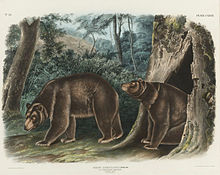
A cinnamon bear by J.T. Bowen after Audubon
During a visit to Philadelphia in 1812 post-obit Congress' declaration of war against Great Uk, Audubon became an American denizen and had to give up his French citizenship.[51] After his return to Kentucky, he institute that rats had eaten his entire collection of more than 200 drawings. Afterwards weeks of depression, he took to the field again, determined to re-practise his drawings to an fifty-fifty higher standard.[52]
The War of 1812 upset Audubon's plans to move his business organisation to New Orleans. He formed a partnership with Lucy'south blood brother and built up their merchandise in Henderson. Betwixt 1812 and the Panic of 1819, times were skillful. Audubon bought land and slaves, founded a flour mill, and enjoyed his growing family unit. After 1819, Audubon went bankrupt and was thrown into jail for debt. The little money he earned was from drawing portraits, particularly death-bed sketches, greatly esteemed by country folk before photography.[53] He wrote, "[M]y heart was sorely heavy, for scarcely had I enough to go along my dear ones alive; and however through these dark days I was being led to the development of the talents I loved."[54]
Early ornithological career [edit]

Plate 181 of The Birds of America by Audubon depicting a golden hawkeye, 1833–34
Audubon worked for a brief time every bit the first paid employee of the Western History Social club, now known as The Museum of Natural History at The Cincinnati Museum Eye.[55] He then traveled south on the Mississippi with his gun, paintbox, and banana Joseph Mason, who stayed with him from October 1820 to August 1822 and painted the institute life backgrounds of many of Audubon's bird studies. He was committed to find and paint all the birds of North America for eventual publication. His goal was to surpass the earlier ornithological piece of work of poet-naturalist Alexander Wilson.[56] Though he could not afford to buy Wilson's work, Audubon used it to guide him when he had access to a copy.
In 1818, Rafinesque visited Kentucky and the Ohio River valley to written report fishes and was a guest of Audubon. In the middle of the dark, Rafinesque noticed a bat in his room and idea information technology was a new species. He happened to take hold of Audubon's favourite violin in an effort to knock the bat downward, resulting in the destruction of the violin. Audubon reportedly took revenge by showing drawings and describing some fictitious fishes and rodents to Rafinesque; Rafinesque gave scientific names to some of these fishes in his Ichthyologia Ohiensis.[57] [58]
On October 12, 1820, Audubon traveled into Mississippi, Alabama, and Florida in search of ornithological specimens. He traveled with George Lehman, a professional person Swiss landscape artist. The following summertime, he moved upriver to the Oakley Plantation in Feliciana Parish, Louisiana, where he taught drawing to Eliza Pirrie, the young girl of the owners. Though depression-paying, the job was ideal, every bit it afforded him much time to roam and paint in the wood. (The plantation has been preserved equally the Audubon State Historic Site, and is located at 11788 Highway 965, between Jackson and St. Francisville.)
Audubon called his time to come piece of work The Birds of America. He attempted to paint one page each twenty-four hours. Painting with newly discovered technique, he decided his earlier works were inferior and re-did them.[59] He hired hunters to gather specimens for him. Audubon realized the ambitious project would take him away from his family for months at a fourth dimension.
Audubon sometimes used his drawing talent to trade for goods or sell pocket-size works to raise cash. He made charcoal portraits on demand at $v each and gave drawing lessons.[sixty] In 1823, Audubon took lessons in oil painting technique from John Steen, a instructor of American landscape, and history painter Thomas Cole. Though he did non use oils much for his bird work, Audubon earned good coin painting oil portraits for patrons along the Mississippi. (Audubon's business relationship reveals that he learned oil painting in December 1822 from Jacob Stein, an afoot portrait artist. After they had enjoyed all the portrait patronage to be expected in Natchez, Mississippi, during January–March 1823, they resolved to travel together as perambulating portrait-artists.)[61] [62] During this period (1822–1823), Audubon likewise worked as an instructor at Jefferson College in Washington, Mississippi.
Lucy became the steady breadwinner for the couple and their two young sons. Trained as a teacher, she conducted classes for children in their dwelling house. Later she was hired as a local teacher in Louisiana. She boarded with their children at the home of a wealthy plantation possessor, every bit was often the custom of the time.[61] [63]
In 1824, Audubon returned to Philadelphia to seek a publisher for his bird drawings. He took oil painting lessons from Thomas Sully and met Charles Bonaparte, who admired his piece of work and recommended he go to Europe to have his bird drawings engraved.[64] Audubon was nominated for membership at the Academy of Natural Sciences of Philadelphia past Charles Alexandre Lesueur, Reuben Haines, and Isaiah Lukens, on July 27, 1824.[65] However, he failed to gather enough support, and his nomination was rejected past vote on Baronial 31, 1824;[65] around the aforementioned time accusations of scientific misconduct were levied past Alexander Lawson and others.[66]
The Birds of America [edit]

With his wife's support, in 1826 at historic period 41, Audubon took his growing collection of work to England. He sailed from New Orleans to Liverpool on the cotton-hauling ship Delos, reaching England in the autumn of 1826 with his portfolio of over 300 drawings.[67] With letters of introduction to prominent Englishmen, and paintings of imaginary species including the "Bird of Washington",[68] Audubon gained their quick attention. "I take been received hither in a mode not to be expected during my highest enthusiastic hopes."[69]


The British could not get plenty of Audubon's images of backwoods America and its natural attractions. He met with great credence as he toured around England and Scotland, and was lionized every bit "the American woodsman". He raised enough money to begin publishing his The Birds of America. This monumental work consists of 435 manus-colored, life-size prints of 497 bird species, made from engraved copper plates of various sizes depending on the size of the paradigm. They were printed on sheets measuring almost 39 past 26 inches (990 by 660 mm).[70] The work illustrates slightly more 700 North American bird species, of which some were based on specimens collected past fellow ornithologist John Kirk Townsend on his journey across America with Thomas Nuttall in 1834 as part of Nathaniel Jarvis Wyeth's second expedition across the Rocky Mountains to the Pacific Ocean.[71] [72]
The pages were organized for artistic upshot and contrasting interest, as if the reader were taking a visual bout. (Some critics idea he should have organized the plates in Linnaean order as befitting a "serious" ornithological treatise.)[73] The first and perchance most famous plate was the wild turkey. Among the earliest plates printed was the "Bird of Washington", which generated favorable publicity for Audubon as his first discovery of a new species. Yet, no specimen of the species has ever been found, and research published in 2020 suggests that this plate was a mixture of plagiarism and ornithological fraud.[74]
The cost of press the entire piece of work was $115,640 (over $ii,000,000 today), paid for from advance subscriptions, exhibitions, oil painting commissions, and animate being skins, which Audubon hunted and sold.[70] Audubon'due south slap-up work was a remarkable achievement. Information technology took more than 14 years of field observations and drawings, plus his single-handed direction and promotion of the projection to get in a success. A reviewer wrote,
All anxieties and fears which overshadowed his work in its kickoff had passed away. The prophecies of kind but overprudent friends, who did not understand his cocky-sustaining free energy, had proved untrue; the malicious hope of his enemies, for fifty-fifty the gentle lover of nature has enemies, had been disappointed; he had secured a commanding place in the respect and gratitude of men.[75]
Colorists applied each colour in assembly-line fashion (over fifty were hired for the work).[76] The original edition was engraved in aquatint past Robert Havell, Jr., who took over the task after the kickoff ten plates engraved by W. H. Lizars were accounted inadequate. Known as the Double Elephant folio for its double elephant paper size, it is oftentimes regarded as the greatest picture book ever produced and the finest aquatint work. By the 1830s the aquatint process had been largely superseded past lithography.[77] A contemporary French critic wrote, "A magic ability transported us into the forests which for and so many years this homo of genius has trod. Learned and ignorant alike were astonished at the spectacle ... It is a real and palpable vision of the New Globe."[78]

Audubon sold oil-painted copies of the drawings to make extra money and publicize the book. A potential publisher had Audubon'southward portrait painted past John Syme, who clothed the naturalist in frontier clothes; the portrait was hung at the archway of his exhibitions, promoting his rustic image. The painting is now held in the White Business firm fine art collection, and is non frequently displayed.[79] The New-York Historical Order holds all 435 of the preparatory watercolors for The Birds of America. Lucy Audubon sold them to the society after her husband'south death. All only 80 of the original copper plates were melted downwardly when Lucy Audubon, desperate for money, sold them for scrap to the Phelps Dodge Corporation.[80]
King George Iv was among the gorging fans of Audubon and subscribed to support publication of the volume. Britain'due south Purple Social club recognized Audubon's achievement past electing him as a fellow. He was the 2nd American to exist elected after statesman Benjamin Franklin. While in Edinburgh to seek subscribers for the book, Audubon gave a sit-in of his method of supporting birds with wire at professor Robert Jameson'due south Wernerian Natural History Association. Educatee Charles Darwin was in the audience. Audubon as well visited the dissecting theatre of the anatomist Robert Knox. Audubon was also successful in France, gaining the King and several of the dignity as subscribers.[81]
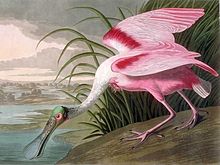
The Birds of America became very popular during Europe'due south Romantic era.[82] Audubon's dramatic portraits of birds appealed to people in this period's fascination with natural history.[82] [83] [84]
Later career [edit]


Audubon returned to America in 1829 to complete more than drawings for his magnum opus. He also hunted animals and shipped the valued skins to British friends. He was reunited with his family. After settling business organisation diplomacy, Lucy accompanied him back to England. Audubon found that during his absence, he had lost some subscribers due to the uneven quality of coloring of the plates. Others were in arrears in their payments. His engraver fixed the plates and Audubon reassured subscribers, simply a few begged off. He responded, "The Birds of America will then heighten in value as much every bit they are at present depreciated by certain fools and envious persons."[85] He was elected a Fellow of the American University of Arts and Sciences[86] in 1830 and to the American Philosophical Lodge[87] in 1831.
He followed The Birds of America with a sequel Ornithological Biographies. This was a collection of life histories of each species written with Scottish ornithologist William MacGillivray. The two books were printed separately to avoid a British law requiring copies of all publications with text to be deposited in copyright libraries, a huge financial brunt for the self-published Audubon.[88] Both books were published between 1827 and 1839.
During the 1830s, Audubon connected making expeditions in North America. During a trip to Key West, a companion wrote in a paper article, "Mr. Audubon is the most enthusiastic and indefatigable man I ever knew ... Mr. Audubon was neither dispirited by estrus, fatigue, or bad luck ... he rose every morning at 3 o'clock and went out ... until 1 o'clock." Then he would describe the rest of the day before returning to the field in the evening, a routine he kept up for weeks and months.[89] In the posthumously published bookThe Life of John James Audubon The Naturalist,[49] edited by his widow and derived primarily from his notes, Audubon related visiting the northeastern Florida coastal sugar plantation of John Joachim Bulow for Christmas 1831/early January 1832. It was started past his father and at four,675 acres, was the largest in East Florida.[90] Bulow had a saccharide mill built there under direction of a Scottish engineer, who accompanied Audubon on an excursion in the region. The mill was destroyed in 1836 in the Seminole Wars. The plantation site is preserved today every bit the Bulow Plantation Ruins Historic State Park.[xc]
In March 1832, Audubon booked passage at St. Augustine, Florida, aboard the schooner Agnes, leap for Charleston, S Carolina. A gale forced the vessel to booth at the mouth of the Savannah River, where an officer of the United States Army Corps of Engineers on Cockspur Island where Fort Pulaski was under construction, transported Audubon upstream to Savannah, Georgia, on their barge. Just equally he was about to board a Charleston-bound phase passenger vehicle, he remembered William Gaston, a Savannah resident who had once befriended him. Audubon stayed at Urban center Hotel, and the next day sought out and found the acquaintance, "who showed but little enthusiasm for his Birds of America" and who doubted that the book would sell a single copy in the urban center.[91] A dejected Audubon connected to talk to the merchant and a common friend who, by chance, had appeared. The merchant, having further considered his position, said, "I subscribe to your work", gave him $200 for the outset volume, and promised to act as his agent in finding boosted subscriptions.[91]
In 1833, Audubon sailed north from Maine, accompanied by his son John, and five other young colleagues, to explore the ornithology of Labrador. On the return voyage, their ship Ripley made a stop at St. George's, Newfoundland. At that place Audubon and his assistants documented 36 species of birds.[92]
Audubon painted some of his works while staying at the Key West house and gardens of Capt. John H. Geiger. This site was preserved as the Audubon House and Tropical Gardens.[93]
In 1841, having finished the Ornithological Biographies, Audubon returned to the United States with his family unit. He bought an manor on the Hudson River in northern Manhattan. (The roughly xx-acre estate came to be known as Audubon Park in the 1860s when Audubon'south widow began selling off parcels of the estate for the development of complimentary-standing single family homes.)[94] Between 1840 and 1844, he published an octavo edition of The Birds of America, with 65 additional plates.[95] Printed in standard format to be more than affordable than the oversize British edition, information technology earned $36,000 and was purchased past 1100 subscribers.[96] Audubon spent much time on "subscription-gathering trips", drumming up sales of the octavo edition, as he hoped to leave his family unit a sizeable income.[97]
Death [edit]
Audubon fabricated some excursions out West where he hoped to record Western species he had missed, only his health began to fail. In 1848, he manifested signs of senility or possibly dementia from what is now called Alzheimer's disease, his "noble heed in ruins".[98] He died at his family home in northern Manhattan on January 27, 1851. Audubon is buried in the graveyard at the Church of the Intercession in the Trinity Church Cemetery and Mausoleum at 155th Street and Broadway in Manhattan, near his home. An imposing monument in his honor was erected at the cemetery, which is now recognized as part of the Heritage Rose Commune of NYC.[99]
Audubon's final work dealt with mammals; he prepared The Viviparous Quadrupeds of North America (1845–1849) in collaboration with his skilful friend Rev. John Bachman of Charleston, Southward Carolina, who supplied much of the scientific text. His son, John Woodhouse Audubon, drew most of the plates. The work was completed by Audubon'due south sons, and the 2nd volume was published posthumously in 1851.
Fine art and methods [edit]
Audubon adult his own methods for drawing birds. First, he killed them using fine shot. He then used wires to prop them into a natural position, unlike the common method of many ornithologists, who prepared and blimp the specimens into a rigid pose. When working on a major specimen like an eagle, he would spend up to four 15-hour days, preparing, studying, and cartoon information technology.[100] His paintings of birds are set true-to-life in their natural habitat. He often portrayed them equally if caught in motion, particularly feeding or hunting. This was in stark contrast to the stiff representations of birds by his contemporaries, such as Alexander Wilson. Audubon based his paintings on his extensive field observations. He worked primarily with watercolor early on. He added colored chalk or pastel to add softness to feathers, especially those of owls and herons.[101] He employed multiple layers of watercoloring, and sometimes used gouache. All species were drawn life size which accounts for the contorted poses of the larger birds equally Audubon strove to fit them within the page size.[102] Smaller species were usually placed on branches with berries, fruit, and flowers. He used several birds in a cartoon to present all views of beefcake and wings. Larger birds were ofttimes placed in their ground habitat or perching on stumps. At times, as with woodpeckers, he combined several species on 1 page to offering contrasting features. He frequently depicted the birds' nests and eggs, and occasionally natural predators, such as snakes. He usually illustrated male person and female variations, and sometimes juveniles. In later drawings, Audubon used assistants to render the habitat for him. In improver to true-blue renderings of anatomy, Audubon also employed advisedly constructed composition, drama, and slightly exaggerated poses to attain artistic as well every bit scientific effects.
-
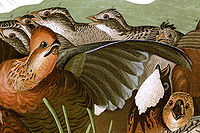
Detail from the adjacent image
Dispute over accuracy [edit]
The success of Birds of America may exist considered to be marred past numerous accusations of plagiarism and scientific fraud.[34] [68] [103] [66] [104] Enquiry has uncovered that Audubon falsified (and fabricated) scientific information,[58] [105] published fraudulent data and images in scientific journals and commercial books,[34] [68] [103] invented new species to print potential subscribers,[68] and to "prank" rivals,[58] [105] and most likely stole the holotype specimen of Harris's militarist (Parabuteo unicinctus harrisi) before pretending not to know its collector, who was 1 of his subscribers.[106] He failed to credit work by Joseph Mason, prompting a series of articles in 1835 past critic John Neal questioning Audubon'due south honesty and trustworthiness.[107] Audubon as well repeatedly lied almost the details of his autobiography, including the place and circumstances of his birth.[108]
The litany of misconduct in Audubon'due south scientific career has fatigued comparisons to others such as Richard Meinertzhagen.[68] Similar to early biographies of Meinertzhagen, Audubon's scientific misconduct has been repeatedly ignored and/or downplayed past biographers,[34] [68] [104] who defend Ornithological Biography as a "valuable resources and a very good read".[109]
Legacy [edit]

Audubon in later years, c. 1850
Audubon's influence on ornithology and natural history was far reaching. Nearly all later ornithological works were inspired by his artistry and loftier standards. Charles Darwin quoted Audubon three times in On the Origin of Species and also in later works.[110] Despite some errors in field observations, he made a pregnant contribution to the understanding of bird anatomy and behavior through his field notes. The Birds of America is still considered ane of the greatest examples of volume fine art. Audubon discovered 25 new species and 12 new subspecies.[111]
- He was elected to the Royal Society of Edinburgh, the Linnean Society, and the Purple Society in recognition of his contributions.
- The homestead Factory Grove in Audubon, Pennsylvania, is open to the public and contains a museum presenting all his major works, including The Birds of America.
- The Audubon Museum at John James Audubon State Park in Henderson, Kentucky, houses many of Audubon's original watercolors, oils, engravings and personal memorabilia.
- In 1905, the National Audubon Society was incorporated and named in his laurels. Its mission "is to conserve and restore natural ecosystems, focusing on birds ..."
- He was honored in 1940 by the U.s.a. Postal service Office with a one cent Famous Americans Series postage stamp; the stamp is light-green.
- He was honored by the United States Postal Service with a 22¢ Great Americans serial stamp stamp.
- On December 6, 2010, a copy of The Birds of America was sold at a Sotheby's sale for $11.5 1000000, the 2nd highest cost for a single printed book.[112]
- On April 26, 2011, Google celebrated his 226th altogether past displaying a special Google Putter on its global homepage.[113]
- Audubon's life and contributions to science and art was the subject area of the 2017 motion-picture show Audubon.
Audubon in popular civilisation [edit]
Audubon is the field of study of the 1969 book-length poem, Audubon: A Vision by Robert Penn Warren.[114] Stephen Vincent Benét, with his wife Rosemary Benét, included a verse form virtually Audubon in the children'southward poetry book A Book of Americans.[115]
Audubon'due south 1833 trip to Labrador is the subject of the novel Creation by Katherine Govier.[116] Audubon and his married woman, Lucy, are the chief characters in the "June" section of the Maureen Howard novel Big equally Life: Three Tales for Spring.[117] In the novel Audubon'south Sentinel, John Gregory Dark-brown explores a mysterious expiry that took place on a Louisiana plantation when Audubon worked there as a immature man.[118]
George Voskovec plays Audubon in the 1952 American motion-picture show The Iron Mistress, which stars Alan Ladd as James Bowie. The picture show imagines a friendship between the ii men.
In 1985, The National Gallery of Art 20C History Projection produced a documentary, "John James Audubon: The Birds of America", at present widely bachelor online.
In July 2007, PBS's American Masters series aired an episode titled "John James Audubon: Fatigued from Nature," [119] Supplemental cloth is available on the PBS website.
Audubon appears in the short story "Audubon In Atlantis" by Harry Turtledove, published in the 2010 collection Atlantis and Other Places.[120]
The choral oratorio Audubon past James Kallembach was premiered on November 9, 2018, in Boston, Massachusetts past Chorus pro Musica.[121] The work depicts scenes of Audubon's life and descriptions of the birds he drew with text drawn from the 2004 biography by Richard Rhodes.[122]
Places named in his honor [edit]

- Audubon Park and Zoo in New Orleans, where he lived beginning in 1821.
- Audubon and Audubon Park, both in New Jersey. Many streets in Audubon Park are named after birds fatigued by him.
- Audubon, Pennsylvania, likewise has the Audubon Bird Sanctuary. Almost of the streets in this pocket-size town are named after birds that he drew.
- Audubon Nature Institute, a family of museums, parks, and other organizations in New Orleans, 8 of which conduct the Audubon name.
- Audubon Park and country club in Louisville, Kentucky, is in the expanse of his former general store.
- Several towns and Audubon County, Iowa.
- John James Audubon Bridge (Mississippi River), connecting Pointe Coupee and Due west Feliciana Parishes; over thirty of Audubon'south bird paintings were created in West Feliciana Parish.
- The northbound span of the Bi-State Vietnam Gold Star Bridges was originally named the Audubon Memorial Bridge.
- Audubon Park, in Memphis, Tennessee, is associated with the nearby Botanic Garden.
- John James Audubon State Park and the Audubon Museum (located within the park) in Henderson, Kentucky.
- Audubon Parkway, as well in Kentucky, is a limited-access highway connecting Henderson with Owensboro, Kentucky.
- Rue Jean-Jacques Audubon in Nantes and Rue Audubon in Paris, France.
- Rue Jean-Jacques Audubon in Couëron, France.
- Lycée Jean-Jacques Audubon in Couëron, France.
- Marais Audubon between Couëron and St Etienne de Mont-luc, France.
- Audubon Circle, a major intersection and neighborhood in Boston, Massachusetts; Park Drive (parkway), which runs through the Audubon Circumvolve, was formerly named Audubon Road.
- John James Audubon Parkway in Amherst, New York.
- Audubon Avenue in New York, New York.
- Audubon Bird Sanctuary, Dauphin Island, Alabama[123]
- Audubon National Wildlife Refuge, Coleharbor, North Dakota
- Audubon Park, a park and neighborhood in Northeast Minneapolis, Minnesota.
- Audubon Park, a park and neighborhood in Orlando, Florida. The streets are named subsequently birds, such every bit Falcon Drive and Raven Road.
- Wildcat Glades Conservation and Audubon Center in Joplin, Missouri.
- Audubon International, a 501(c)(3) not-for-turn a profit organization that administers a wide range of environmental teaching and certification programs on backdrop such as golf courses, hotels, schoolhouse campuses, ski areas, cemeteries, corporate parks, and agricultural lands.[124]
- The Scioto Audubon Metro Park in Columbus, Ohio[125]
- Audubon Recreation Eye in Garland, Texas.[126]
- Mount Audubon (13223 ft), Colorado
- Audubon High School in Camden County, New Jersey, and many primary schools around the United States
- Audubon Golf Trail - a collection of golf courses spread throughout Louisiana
- John James Audubon Uncomplicated School in Chicago, Illinois.[127]
- Pascagoula River Audubon Eye in Moss Point, Mississippi.[128]
- Audubon House & Gallery in Central West, Florida.[129]
- Audubon Street, home to the Audubon Arts District and The Audubon New Haven apartment building, in New Haven, Connecticut
Surviving bird specimens [edit]
Some of Audubon's bird specimens survive in the collections of the Natural History Museum, London,[130] the Academy of Natural Sciences, Philadelphia,[131] and at that place are five specimens in the collections of Globe Museum, National Museums Liverpool.
Works [edit]
Posthumous collections [edit]
- John James Audubon, Selected Journals and Other Writings (Ben Forkner, ed.) (Penguin Nature Classics, 1996) ISBN 0-14-024126-4
- John James Audubon, Writings & Drawings (Christoph Irmscher, ed.) (The Library of America, 1999) ISBN 978-ane-883011-68-0
- John James Audubon, The Audubon Reader (Richard Rhodes, ed.) (Lowest Library, 2006) ISBN ane-4000-4369-7
- Audubon: Early Drawings (Richard Rhodes, Scott 5. Edwards, Leslie A. Morris) (Harvard University Printing and Houghton Library 2008) ISBN 978-0-674-03102-nine
- John James Audubon, Audubon and His Journals (The European Journals 1826–1829, the Labrador Journal 1833, the Missouri River Journals 1843), edited by Maria Audubon, volumes ane and ii, originally published past Charles Scribner's Sons in 1897 (in
 Wikisource).
See also [edit]
- Audubon House and Tropical Gardens, Key Due west, Florida
- Audubon International
- Audubon Mural Project
- Audubon Park Celebrated Commune, New York City
- Audubon State Historic Site, West Feliciana Parish, Louisiana
- List of wild animals artists
- National Audubon Social club
- Passenger pigeon
References [edit]
Citations [edit]
- ^ Oxford illustrated encyclopedia. Guess, Harry George., Toyne, Anthony. Oxford [England]: Oxford Academy Press. 1985–1993. p. 26. ISBN0-19-869129-seven. OCLC 11814265.
{{cite volume}}: CS1 maint: others (link) - ^ "Dwelling". Audubon . Retrieved August 6, 2020.
- ^ "Avibase advanced search: [Author = "Audubon"]". Avibase: The World Bird Database . Retrieved August 6, 2020.
- ^ Milman, Oliver (October 25, 2021). "US conservation group to drop Audubon name over 'pain' caused past slaveholder". The Guardian.
- ^ Nelson, Randy F. The Almanac of American Letters. Los Altos, California: William Kaufmann, Inc., 1981: 26. ISBN 0-86576-008-10
- ^ a b Rhodes, Richard John James Audubon: The Making of an American, New York: Alfred A. Knopf, 2004, p. 4, accessed April 26, 2011.
- ^ Sometimes, information technology is written "Rabin"
- ^ a b Souder 2005, p. eighteen
- ^ The Popular science monthly. MBLWHOI Library. [New York, Popular Science Pub. Co., etc.] 1887.
{{cite volume}}: CS1 maint: others (link) - ^ a b DeLatt, Carolyne E., Lucy Audubon: A Biography (LSU Press, 2008), p. 21
- ^ Rhodes, John James Audubon (2004), p. half-dozen
- ^ Souder 2005, p. 19
- ^ Alice Ford, Audubon By Himself, The Natural History Press, Garden City, NY: 1969, p. 4
- ^ Rhodes, JJ Audubon (2004), p. half-dozen
- ^ a b Souder 2005, p. 20
- ^ Shirley Streshinsky, Audubon: Life and Art in the American Wilderness, Villard Books, New York, 1993, ISBN 0-679-40859-two, p. 13
- ^ Stanley Clisby Arthur, Audubon" An Intimate Life of the American Woodsman (Pelican Publishing, 1937), p. 478
- ^ Rhodes 2004, p. 22
- ^ Ford 1969, p. iii
- ^ a b Rhodes 2004, p. five
- ^ Streshinsky 1993, p. 14
- ^ Streshinsky 1993, pp. 16–17
- ^ Rhodes, John James Audubon (2004), pp. iii–4
- ^ Sharpe, Mary Rozier and James, Louis, Betwixt the Gabouri, History of the Rozier Family unit, 1981
- ^ Rhodes, John James Audubon (2004), p.
- ^ "National Gallery of Fine art". Nga.gov. Archived from the original on April 12, 2010. Retrieved Dec x, 2010.
- ^ Ford 1969, p. ten
- ^ Streshinsky 1993, p. 24
- ^ Rhodes 2004, p. 11
- ^ Streshinsky 1993, p. 39
- ^ Rhodes 2004, p. 32
- ^ Rhodes 2004, p. 38
- ^ Gill, Frank (2006). Ornithology. W. H. Freeman; 3rd edition. ISBN978-0-7167-4983-seven.
- ^ a b c d east f Halley, Matthew R. (2018). "Audubon'due south famous banding experiment: fact or fiction?". Archives of Natural History. 45: 118–121. doi:10.3366/anh.2018.0487.
- ^ Audubon, John James (1834). Ornithological Biography, book 2. Vol. 2. Edinburgh, Scotland: Adam & Charles Black.
- ^ "Drove: John James Audubon letters and drawings | HOLLIS for". hollisarchives.lib.harvard.edu . Retrieved Baronial vi, 2020.
- ^ Weatherhead, Patrick J.; Forbes, Mark R. 50. (December one, 1994). "Natal philopatry in passerine birds: genetic or ecological influences?". Behavioral Environmental. 5 (4): 426–433. doi:10.1093/beheco/5.4.426. ISSN 1045-2249.
- ^ "John James Audubon Timeline", American Masters, PBS. Retrieved February 7, 2009.
- ^ Appletons' annual cyclopaedia and register of important events of the year: 1862. New York: D. Appleton & Visitor. 1863. p. 672.
- ^ Rhodes 2004, p. 55
- ^ a b Streshinsky 1993, p. 64
- ^ Rhodes 2004, pp. 83–85
- ^ Rhodes 2004, p. 166
- ^ Ford 1969, p. 24
- ^ Agreement from Francis Hobart Herrick, Ph.D., Sc.D.D., Audubon the Naturalist: A History of His Life and Fourth dimension. Appleton and Company, New York, London, 1917, p. 359.
- ^ Original hand-written receipt of the financial exchange per the Understanding, Missouri Historical Lodge, St. Louis, Missouri. "Ste. Genevieve April 6, 1811, $one,000.000, Half dozen Months subsequently engagement I promise to pay Mr. John Audubon or Orders One Thousand Dollars Value without (unreadable). Signed Ferdinand Rozier (signature torn off), Witnessed: John Lecite, John McAuthur"
- ^ Rozier, Firmin A. (1890). History of the Early Settlement of the Mississippi Valley.
- ^ Ford 1969, p. 56
- ^ a b His widow, ed. (1869). The Life of John James Audubon the Naturalist. New York: G. P. Putnam & Son.
- ^ Ford 1969, p. 57
- ^ Rhodes 2004, p. 105
- ^ Rhodes 2004, p. 116
- ^ Ford 1969, p. 85
- ^ Rhodes 2004, p. 143
- ^ "An exhibition opening for In the Audubon Tradition". Cincy Museum Center . Retrieved Nov vii, 2019.
- ^ Ford 1969, p. 25
- ^ Markle, Douglas F. (1997). "Audubon's hoax: Ohio River fishes described past Rafinesque". Archives of Natural History. 24 (three): 439–447. doi:10.3366/anh.1997.24.3.439.
- ^ a b c Woodman, Neal (2016). "Pranked by Audubon: Constantine Due south. Rafinesque's description of John James Audubon'southward imaginary Kentucky mammals" (PDF). Archives of Natural History. 43 (1): 95–108. doi:ten.3366/anh.2016.0349.
- ^ Rhodes 2004, p. 209
- ^ Streshinsky 1993, p. 102
- ^ a b Punke, p. 21
- ^ Arthur, pp. 256–57
- ^ Arthur, pp. 258–59
- ^ Punke, p. 225
- ^ a b Halley, Matthew R. (2018). "Lost Tales of American Ornithology: Reuben Haines and the Canada Geese of Wyck (1818–1828)" (PDF). Cassinia. 76: 63.
- ^ a b Dunlap, William (1834). History of the ascension and progress of the arts of blueprint in the Us, Volume 2. New York, NY: George P. Scott & Co., New York.
- ^ Rhodes 2004, p. 237
- ^ a b c d e f Halley, Matthew R. (June 2020). "Audubon'southward Bird of Washington: unravelling the fraud that launched The birds of America". Bulletin of the British Ornithologists' Lodge. 140 (2): 110–141. doi:10.25226/bboc.v140i2.2020.a3. ISSN 0007-1595.
- ^ Rhodes 2004, p. 261
- ^ a b Rhodes 2004, p. 403
- ^ Mearns, B. & R., John Kirk Townsend: Collector of Audubon'southward Western Birds and Mammals (2007)
- ^ Townsend, John Kirk, Excursion to the Oregon, Edinburgh: Due west. and R. Chambers, 1846
- ^ Rhodes 2004, p. 303
- ^ Halley, Matthew R. (June 22, 2020). "Audubon's Bird of Washington: unravelling the fraud that launched The birds of America". Bulletin of the British Ornithologists' Society. 140 (2): 110–141. doi:10.25226/bboc.v140i2.2020.a3.
- ^ Streshinsky 1993, p. 328
- ^ Rhodes 2004, pp. 273, 389
- ^ Rhodes 2004, p. 300
- ^ Rhodes 2004, p. 279
- ^ Rhodes 2004, p. 276
- ^ "John James Audubon Relate", Cleveland Museum of Natural History, press release, February 1, 2007 Archived July 20, 2008, at the Wayback Machine
- ^ Rhodes 2004, p. 316
- ^ a b National Audubon Society Inc. (n.d.) John James Audubon Retrieved from [one]
- ^ Lyons, 1000. (2011). Books A Living History. Los Angeles, California: Getty Publications.
- ^ Lyons 2011, pp. 135–36
- ^ Rhodes 2004, p. 392
- ^ "Book of Members, 1780–2010: Chapter A" (PDF). American University of Arts and Sciences. Retrieved Apr 27, 2011.
- ^ "APS Member History". search.amphilsoc.org . Retrieved April 8, 2021.
- ^ Rhodes 2004, p. 273
- ^ Rhodes 2004, p. 366
- ^ a b "Dedication ceremonies for Bulow Plantation Ruins Historic State Park – Bunnell, Florida", Florida Retentiveness, accessed March 14, 2015.
- ^ a b Ease and Elegance, Madeira and Murder: The Social Life of Savannah's City Hotel, Malcolm Bell, Jr. (1992), p. 558
- ^ Constrict, Leslie. Montevecchi, William. Nuttall Ornithological Club. Newfoundland Birds, Exploitation, Report, Conservation, Harvard University Printing, 1987.
- ^ Cox, C. 1983. A Key Westward Companion. Macmillan. pp. 49–51. ISBN 0-312-45183-0
- ^ Most, Jennifer L. et al. Audubon Park Historic District Designation Report New York Urban center Landmarks Preservation Commission (May 12, 2009), p. iii, paragraph 2.
- ^ Audubon, John James (1840–1844). The Birds of America: From Drawings Made in the United States and their Territories. New York: J.B. Chevalier – via Biodiversity Heritage Library.
- ^ Rhodes 2004, p. 430
- ^ Chancellor, John (1978). Audubon : A Biography. New York: Viking Press. p. 210. ISBN978-0-670-14053-iv.
- ^ Streshinsky 1993, p. 361
- ^ "What is the Heritage Rose District of NYC?". mbpo.org. Archived from the original on July 18, 2011.
- ^ Rhodes 2004, p. 375
- ^ Rhodes 2004, p. 163
- ^ Gardner, Albert TenEyck (1963). "John James Audubon and Campephilus Principalis". The Metropolitan Museum of Fine art Bulletin. 21 (9): 309–316. doi:x.2307/3257944. ISSN 0026-1521. JSTOR 3257944.
- ^ a b Ord, George (1840). "Minutes from the Stated Coming together, September xviii [1840]". Proceedings of the American Philosophical Society. 1: 272.
- ^ a b Hunter, Clark (1983). The Life and Letters of Alexander Wilson. Philadelphia, Pennsylvania: Memoirs of the American Philosophical Club. ISBN978-0-87169-154-five.
- ^ a b MARKLE, DOUGLAS F. (Oct 1, 1997). "Audubon'southward hoax: Ohio River fishes described by Rafinesque". Archives of Natural History. 24 (3): 439–447. doi:x.3366/anh.1997.24.3.439. ISSN 0260-9541.
- ^ Fries, Waldemar H. (2006). The Double Elephant Folio. Zenaida Publishing Co. ISBN978-0-9770829-0-ii.
- ^ Richards, Irving T. (May 1934). "Audubon, Joseph R. Mason, and John Neal". American Literature. 6 (2): 122–140. doi:10.2307/2919790. JSTOR 2919790.
- ^ DALLETT, FRANCIS JAMES (1959). "Citizen Audubon: A Documentary Discovery". The Princeton Academy Library Chronicle. 21 (1/2): 89–93. doi:10.2307/26409602. ISSN 0032-8456. JSTOR 26409602.
- ^ Nobles, Gregory (July 31, 2020). "The Myth of John James Audubon". Audubon.org.
- ^ Rhodes 2004, p. 306
- ^ "John James Audubon: Drawn from Nature", American Masters, PBS. Retrieved February 7, 2009.
- ^ Van Biema, David (January ii, 2014). "Bay Psalm Book fetches $14.2 meg in tape auction". charlotteobserver.com. Archived from the original on January 4, 2014. Retrieved January iii, 2014.
- ^ Ben Quinn (November 26, 2008). "John James Audubon's birthday celebrated past Google doodle". Guardian . Retrieved April 26, 2011.
- ^ Robert Penn Warren (October i, 1998). The Collected Works of Robert Penn Warren. ISBN978-0-8071-2333-1 . Retrieved October 26, 2014.
- ^ Benét, Stephen Vincent (1987). A Book of Americans (Reprint ed.). Henry Holt and Co. ISBN0-8050-0284-7.
- ^ Govier, Katherine (2002). Creation. New York: Overlook Printing. ISBN1-58567-410-9.
- ^ Howard, Maureen (2001). Big as Life: Three Tales for Bound. New York: Viking. ISBN0-670-89978-10.
- ^ Chocolate-brown, John Gregory (2001). Audubon's Scout. New York: Houghton Mifflin. ISBN0-395-78607-X.
- ^ "John James Audubon ~ Drawn from Nature | American Masters | PBS". American Masters. July 25, 2007. Retrieved September iii, 2021.
- ^ Turtledove, Harry (2011). Atlantis and Other Places. ROC. ISBN978-0-451-46387-six.
- ^ "Audubon: An American Chance Takes Flight". Retrieved May 22, 2019.
- ^ Rhodes 2004
- ^ "Dauphin Island Park and Beach Audubon Bird Sanctuary on Dauphin Island". Dauphin Island Park and Beach . Retrieved July 9, 2015.
- ^ "Audubon International". auduboninternational.org . Retrieved July ix, 2015.
- ^ "Scioto Audubon". Metro Parks – Central Ohio Park System . Retrieved July 9, 2015.
- ^ "Garland Texas – Audubon Recreation Middle". garlandparks.com . Retrieved July 9, 2015.
- ^ "Audubon School". Retrieved December 31, 2019.
- ^ "Pascagoula River Audubon Center". Pascagoula River Audubon Centre . Retrieved July 20, 2020.
- ^ "John Audubon House & Gallery". audubonhouse.org . Retrieved October 3, 2020.
- ^ "Bird pare collections | Natural History Museum". world wide web.nhm.ac.uk . Retrieved March 23, 2022.
- ^ British Ornithologists' Club.; Club, British Ornithologists' (2016). Message of the British Ornithologists' Lodge. Vol. 136. London: British Ornithologists' Club.
- ^ IPNI. Audubon.
Bibliography [edit]
- Anon. (1887) Sketch of J.J. Audubon. The Pop Science Monthly. pp. 687–692.
- Arthur, Stanley Clisby (1937). Audubon; An Intimate Life of the American Woodsman. New Orleans: Harmanson. OCLC 1162643 view excerpts online
- Audubon, Lucy Green Bakewell, ed. (1870). The Life of John James Audubon, the Naturalist. New York: G.P.Putnam & Sons.
- Burroughs, J. (1902). John James Audubon. Boston: Modest, Maynard & company. OCLC 648935
- Chalmers, John (2003). Audubon in Edinburgh and his Scottish Associates. NMS Publishing, Edinburgh, 978 ane 901663 79 2
- Ford, Alice (1969). Audubon By Himself. Garden Metropolis NY: The Natural History Press
- Ford, Alice (1964; revised 1988). John James Audubon. Academy of Oklahoma Press
- Fulton, Maurice 1000. (1917). Southern Life in Southern Literature; selections of representative prose and poetry. Boston, New York [etc.]: Ginn and Co. OCLC 1496258 view online here
- Jackson E Christine (2013). John James Audubon and English Perspective Christine E Jackson
- Herrick, Francis Hobart (1917). Aububon the naturalist: A History of his Life and Time. D. Appleton and Visitor, New York. Volume IVolume II (combined 2d 1938 edition)
- Logan, Peter (2016). Audubon: America'due south Greatest Naturalist and His Voyage of Discovery to Labrador. San Francisco, California: Ashbryn Printing. ISBN978-0-9972282-1-two.
- Olson, Roberta J.1000. (2012). Audubon'due south Aviary: The Original Watercolors for The Birds of America. New York: Skira/Rizzoli and New-York Historical Society. ISBN 978-0-8478-3483-9
- Olson, Roberta J.M. (2021). "Hiding in Plain Sight: New Evidence about the Nascency, Identity, and Strategic Pseudonyms of John James Audubon". Message of the Museum of Comparative Zoology. 163 (4): 129–150. doi:ten.3099/MCZ70. ISSN 0027-4100. Discusses the series of names assigned to Audubon as a youth.
- Punke, Michael (2007). Concluding Stand: George Bird Grinnell, the Battle to Save the Buffalo, and the Nascency of the New Due west. Smithsonian Books. ISBN 978-0-06-089782-half-dozen
- Rhodes, Richard (2004). John James Audubon: The Making of an American. New York: Alfred A. Knopf. ISBN 0-375-41412-6
- St. John, Mrs. Horace (1884). Life of Audubon, the naturalist of the New Globe, His Adventures and Discoveries. Philadelphia: J.B.Lippincott & Co.
- Small-scale, East., Catling, Paul M., Cayouette, J., and Brookes, B (2009). Audubon: Beyond Birds: Found Portraits and Conservation Heritage of John James Audubon. NRC Enquiry Press, Ottawa, ISBN 978-0-660-19894-1
- Souder, William (2005) Nether a Wild Heaven: John James Audubon and the Making of The Birds of America. New York: Macmillan. ISBN 0-86547-726-4
- Streshinsky, Shirley (1993). Audubon: Life and Fine art in the American Wilderness. New York: Villard Books, ISBN 0-679-40859-2
External links [edit]
- Audubon Birds of America at New York Historical Society
- Works past John James Audubon at Project Gutenberg
- Works past or about John James Audubon at Internet Archive
- Works by John James Audubon at Toronto Public Library
- Works past John James Audubon at LibriVox (public domain audiobooks)

- John James Audubon at American Art Gallery
- Audubon'south Birds of America at the University of Pittsburgh, a complete high resolution digitization of all 435 double elephant folios also every bit his Ornithological Biography
- The John James Audubon Collection, Houghton Library, Harvard University
- "Audubon biography", National Audubon Social club
- "Louise Hauss and David Brent Miller Audubon Drove", Jule Collins Smith Museum of Fine art, Auburn University
- John James Audubon Country Park in Henderson, Kentucky
- Audubon's Birds of America, podcast from the Beinecke Library, Yale University
- John James Audubon and Audubon family letters, (ca. 1783–1845) from the Smithsonian Archives of American Art
- View works by John James Audubon online at the Biodiversity Heritage Library.
- Watercolors for Birds of America at the New York Historical Society
- Burgwin Family Papers, 1844–1963, AIS.1971.14, Archives Service Center, University of Pittsburgh. Includes Audubon-Bakewell family unit materials.
- John James Audubon Collection at the Library of Congress
- Identification guide to Audubon print editions
- Blue jay: Corvus cristatus by John James Audubon at the Cleveland Public Library Art Collection
- Victor Gifford Audubon Collection. Full general Collection, Beinecke Rare Book and Manuscript Library, Yale Academy.
0 Response to "What Type of Art Did John James Audubon Have"
Post a Comment